
In our group, we study the immune system on different scales: from single cells such as macrophages to smaller tissue sections during psoriatic outbreaks to the scale of a whole organism when fighting parasites like Helminths. Physical interactions thereby not only play a key role in the ability of the immune cells to respond to pathogen threats, but also in the interaction between immune cells. To better understand the interaction between key players of the immune system, we use mathematical and physical models to simulate highly complex reactions of the immune system.
Morphodynamic changes and sampling mechanism of Resident Tissue Macrophages
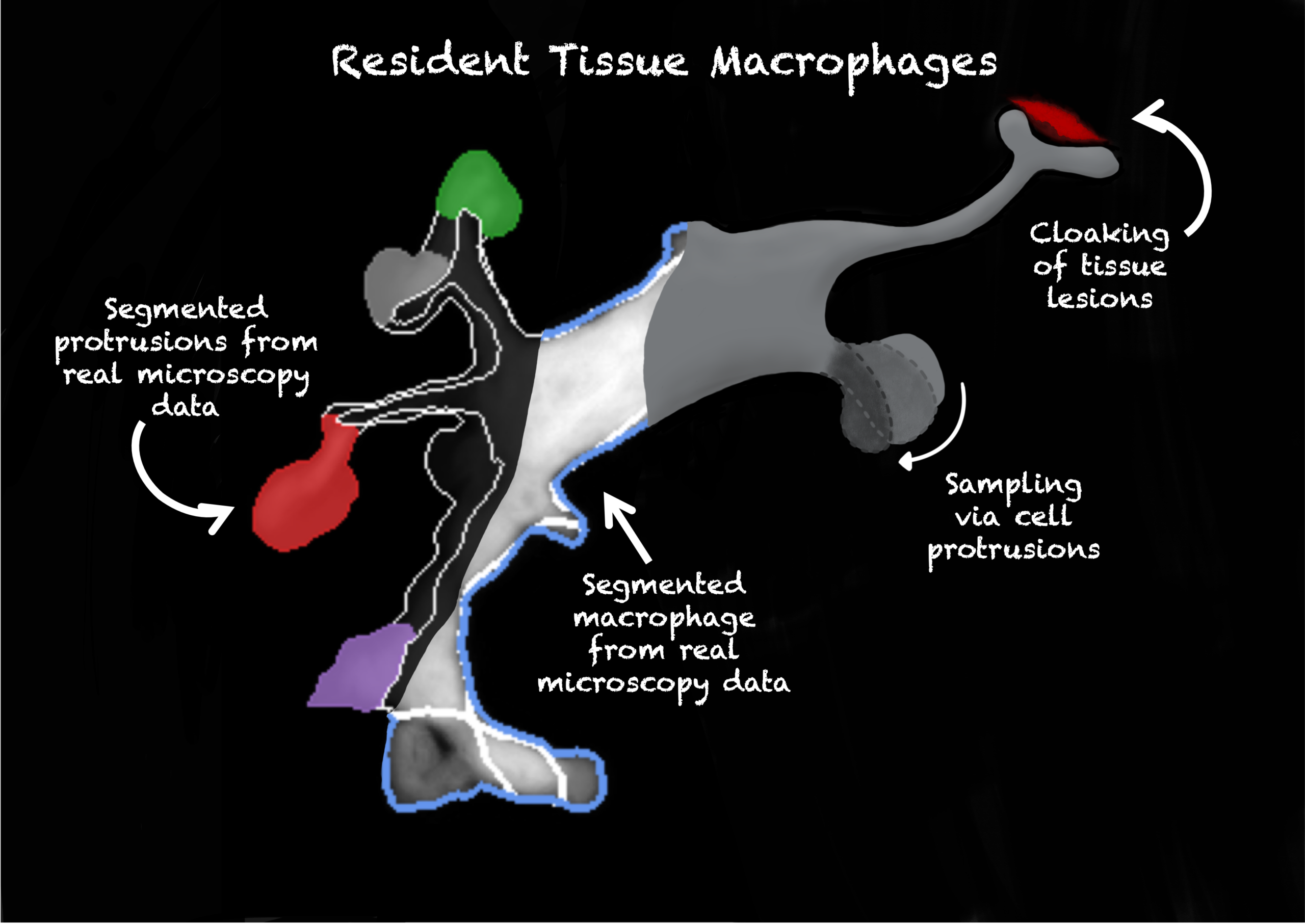
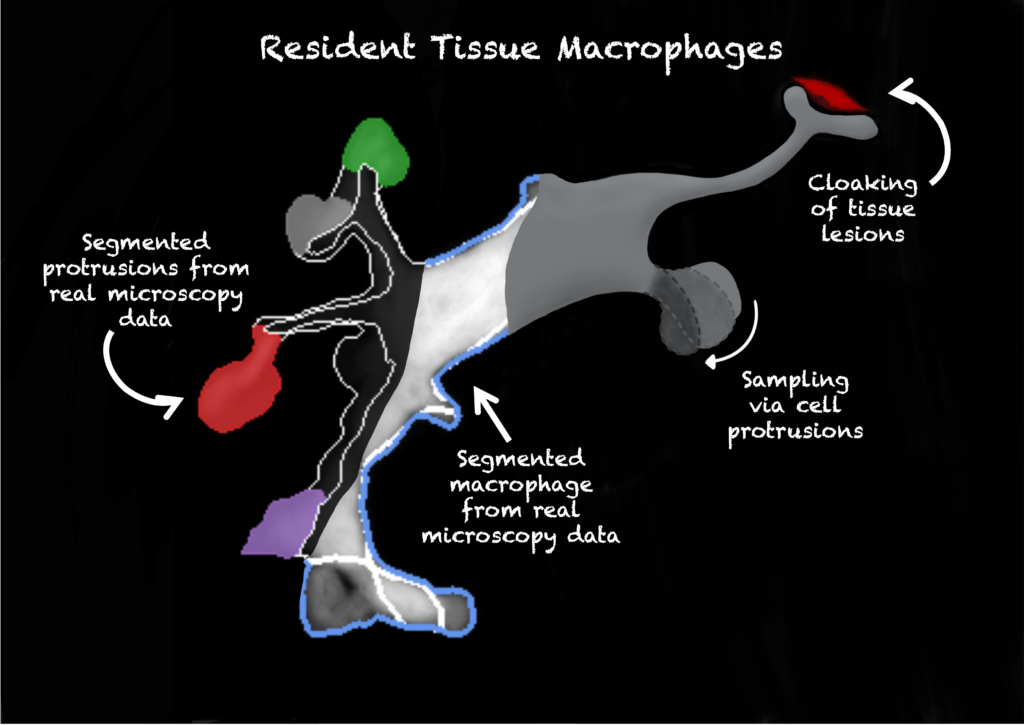
Our tissues are constantly exposed to various stresses — such as pathogens or dead cells and debris — which can cause unnecessary inflammation. To quickly resolve such incidents and keep tissues in homeostasis, Resident Tissue Macrophages (RTMs) reside in essentially every tissue in the body where they constantly monitor their environment. This so-called sampling is associated with characteristic morphological shape changes providing crucial information about the activation state of RTMs and how they ensure tissue homeostasis. Together with our collaborators (group of Stefan Uderhardt, Uniklinikum Erlangen), we built an advanced image analysis pipeline to assess the morphodynamics of RTMs from high-resolution intra-vital imaging data. We found that RTMs in steady state span a surprisingly broad naïve morphospace, within which they shift — but rarely leave — upon stimulation. Strikingly, the analysis pipeline detected the detrimental effects of ageing on RTMs and demonstrated how addition of a specific cytokine alleviates such effects and could potentially restore tissue homeostasis. When focusing on individual cell protrusions, we discovered that their periodic sampling motion covers a surprisingly small space. Astonishingly, protrusions of the same cell show a division of labour in terms of their sampling radius, size and lifetime, hinting at different tasks and functions they need to fulfil.
Some reference
- Cellular morphodynamics as quantifiers for functional states of resident tissue macrophages in vivo; Schnitzerlein M., Greto E., Wegner A., Möller A., Aust O., Ben Brahim O., Blumenthal DB., Zaburdaev V., Uderhardt S. PLoS Computational Biology 21 (2025) e1011859
Defense against Helminths
Parasitic worms — also known as helminths — infect millions of people worldwide, causing significant morbidity as well as further complications in the form of malnutrition and anaemia, thus leading to decreased productivity and quality of life in adults and developmental delays in children. Helminths trigger a type 2 immune response in the body of the host, initiated via the interleukins IL-4, IL-5 and IL-13. The transcription factor and signaling protein STAT6 is the linchpin of this response. It is activated by the interleukins and in turn mediates the further downstream effects — such as differentiation of T-cells, class switching of immunoglobulins, activation of macrophages via an alternative pathway, etc. — that comprise the type 2 immune response. In contrast to the type 1 immune response, which activates against intracellular pathogens such as bacteria and viruses, the type 2 response is much broader as well as less well-understood. In our group, we work closely with experimental collaborators to develop mathematical models of the type 2 immune response in the context of helminth parasites, especially focusing on the ways in which the host immune responses and the parasites’ defense mechanisms interact and influence each other.
Nippostrongylus brasiliensis is a gastrointestinal nematode parasite that infects rodents. Because of its similarities to hookworms that infect humans, it is widely studied in the laboratory as a model parasite. Together with our collaborator Prof. David Vöhringer at the Institute of Microbiology of the University Clinic, we have developed a phenomenological mean field population dynamics model that captures the complex lifecycle of this parasite inside the host. This model will help us develop a broader understanding of how STAT6 shapes the host-immune microenvironment during helminth infection. We are currently working on modelling the role of metabolic pathways in the small intestine of the host and how it regulates the type 2 immune response, especially focusing on the metabolism of tryptophan and tyrosine . We will solve this immune signaling network of interacting cells by applying nonlinear dynamics and numerical methods. This outcome of this model will help us link with the previously developed phenomenological model that replicate the dynamics of the parasite load in different organs of the host. Concurrently, we are also developing an Active Brownian Particle-based model of the escape behavior of the parasite Heligmosomoides polygyrus bakeri — another rodent parasite that functions as a model for human hookworms — from the granulomas that it forms in the lumen of the host intestines as part of its lifecycle. We further plan to use advanced image analysis approaches to analyze this escape behavior from experiments and compare the experimental results to our model.

Hidden mechanisms of autoimmune diseases

Autoimmune diseases and similar autoinflammatory diseases (AIIDs) are a group of disorders caused by immune system dysregulation, in which the immune system recognizes host molecules as pathogenic and develops an immune response against the host itself. One prominent example of such disorders is psoriasis. It is an immune-driven skin disorder characterized by the appearance of erythematous scaly plaques on the skin surface. As with other AIIDs, there is no universal cure for psoriasis, but combined therapeutic approaches can mitigate the symptoms for some time. At the same time, there is still no clear understanding of the disease onset mechanisms, which makes it an exciting and complex problem involving a tangled network of different immune cell types from both adaptive and innate immunity, various molecular signals such as cytokines, chemokines, antimicrobial peptides, and proteases, as well as skin cells. The process may even extend further to the nervous system, involving nerve cells and neuropeptides.
Together with our collaborators Prof. G.C.L. Wong (UCLA, also Rosalind-Franklin Scientist in Residence at MPZPM) and Prof. R. Gallo (UCSD) we want to untangle this challenging signaling network of interacting cells and molecules and describe it using mathematical and computational models. By applying dynamical systems theory, numerical calculations, statistical analysis, we are able to identify the most and least influential interactions, classify and reproduce known clinical states, and even simulate potential therapies within the model. We are using state of the art physics informed machine learning approaches to integrate biomedical data into our models and thus combine theory and experiment.